The Wheel of Consent: The Foundation of Our Work
In this article, we would like to introduce the Wheel of Consent and explain why it plays such an important role in our work.
The Wheel of Consent is a framework that offers profound insights into the dynamics of consent, touch, and personal boundaries. While we cannot provide a comprehensive exploration of the model in this article, we hope to give you a first understanding of its core ideas. If you would like to learn more about the Wheel of Consent, we warmly invite you to explore it on visit Dr. Betty Martin’s website, where you will find extensive information about the model she developed.
KuschelRaum is listed on Dr. Betty Martin’s School of Consent website as a trusted provider.
You can also watch a conversation between Dr. Betty Martin, Angeline Heilfort, and Rubem Joy Fockink, where they discuss the importance of creating safe, non-sexual spaces for exploring touch.

Contents
What Is the Wheel of Consent?
The Wheel of Consent, developed by Dr. Betty Martin, is a model that is widely used in bodywork, therapy, and personal development. It provides a framework for exploring consent, touch, and personal boundaries.
The Wheel is based on two fundamental questions:
- Who is doing the action?
- Who is the gift for?
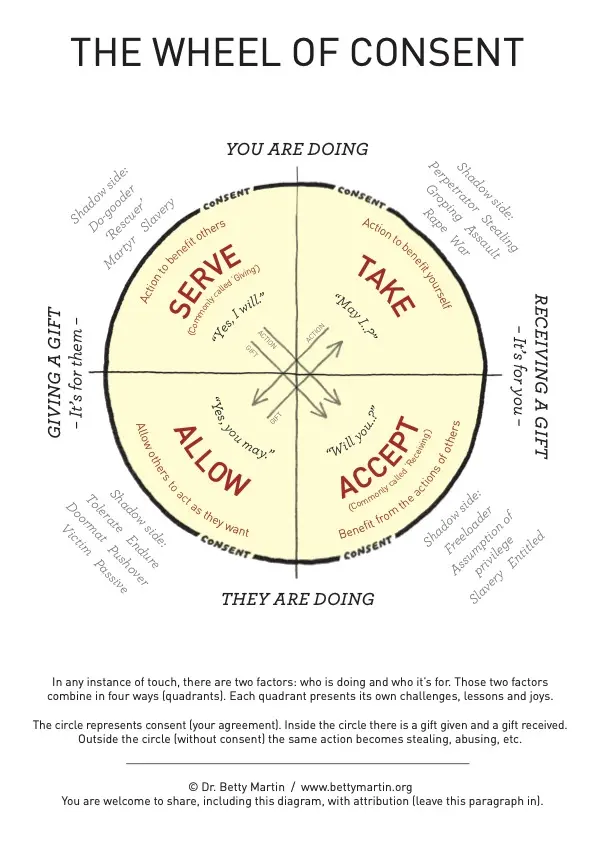
These two questions create the four quadrants of the Wheel, illustrated in the chart below.
Serving
This refers to a person performing an action—such as touching, massaging, or another form of interaction—for the benefit of another person. They are giving a gift.
Receiving
This refers to a person receiving an action for their own benefit—whether touch, massage, or another form of interaction. They are receiving a gift.
Taking
This refers to a person performing an action for their own benefit and enjoyment—whether touch, massage, or another form of interaction. They are receiving a gift.
Allowing
This refers to a person agreeing to an action performed by another person for that other person’s benefit and enjoyment. They are giving a gift.
Beyond the four quadrants, the Wheel also invites a particular ethical mindset that should be present in every interaction. This is symbolised by the circle surrounding the four quadrants, representing consent. Only interactions to which everyone involved has explicitly said „Yes“ take place within the Wheel.
This ethical mindset invites us to practise two essential principles:
- Self-Responsibility
This means taking responsibility for our own actions and deciding for ourselves what we do—or do not—want to do and experience. - Care for the Other
This means not only considering another person’s needs and boundaries, but respecting them completely.
When these principles are not upheld, the Wheel—the shared agreement—is broken, and people move into the shadow side of the respective quadrants. They may become, for example, perpetrators, pushovers, or freeloaders. (You can find more about this in the chart below. Yes, the language is very vivid, but it captures remarkably well what happens when people force, ignore, or allow agreements to be broken.)
Working with the Wheel of Consent enables people to explore and communicate their own desires and boundaries while also respecting the desires and boundaries of others. In this way, it fosters a deeper understanding of consent, autonomy, and respect in human relationships, especially in situations involving touch and physical closeness.
The Wheel of Consent: A Tool for Bodyworkers
The Wheel of Consent was originally developed for bodyworkers and their work. At its core, it is a tool for creating awareness of different qualities of touch (Serving or Taking? Receiving or Allowing?) and for encouraging clients to become more self-determined.
For example, it is not enough for a massage to be described as simply „okay.“ It should feel genuinely good. And only the client can know when that is truly the case, because every body has its own unique history and responds differently.
Unfortunately, many massage therapists work rather mechanically, simply going through the massage techniques they have learned instead of consciously listening to the body they are touching and asking for feedback along the way.
Even when they do ask for feedback, it is not enough merely to hear it. The real challenge—and unfortunately not always an easy one—is to take that feedback seriously and respond to it with appreciation and gratitude, rather than feeling offended because someone without professional training did not appreciate what the therapist considered to be exceptional touch.
Your Well-Being Is No Less Important Than Anyone Else’s
One of the greatest gifts of the Wheel of Consent is the understanding that we alone are responsible for our own bodies—and that we have every right to stand up for ourselves.
Using a massage as an example, this means that clients have the right to ask for changes and adjustments until the touch truly feels right for them. It is not their responsibility to protect the massage therapist’s ego or to worry about asking for too much. At the same time, it is their responsibility to respect the therapist’s boundaries—for example, if the therapist does not have the physical strength to maintain a certain level of pressure for an extended period.
The same principle applies in our personal lives. We can learn to place ourselves more at the centre of our own lives—without walking over other people in the process. We can learn to listen to what truly feels right for us, for our relationships, our experiences of touch, and our path through life.
Our bodies serve as wonderful compasses, constantly sending us honest signals. The body does not lie.
The Body as a Compass
It is a great gift to become increasingly aware of how clear the signals our bodies send us really are: „Yes. More. No. Stop!“
When we do not listen to our bodies and ignore these signals out of politeness, convenience, or fear of hurting someone else (choosing instead to hurt ourselves), our bodies become tense, contract, freeze, or go numb.
The more we listen to our bodies and take their signals seriously, the softer and more open they become—and so do we. We can feel again. We can surrender and let go. Our bodies can finally relax because they trust us again. They no longer have to remain tense and vigilant, constantly anticipating that their boundaries will be crossed.
What happens then is truly magical. New and more intense sensations begin to emerge, bringing moments of deep happiness. Knowing that our „No“ is clear and meaningful gives us freedom—the freedom to choose. And when a „No“ is possible, our „Yes“ becomes far more powerful. Our „Yes“ feels so much more beautiful when it comes wholeheartedly.
All of this—and much more—only became truly clear to us through meeting Dr. Betty Martin and discovering her work. We wholeheartedly recommend her Wheel of Consent workshops.
One of our Cuddle Therapy sessions—“Your Body, Your Compass„—is dedicated specifically to this journey of reconnecting with your body’s wisdom.
A Foundation of Our Work at KuschelRaum
At KuschelRaum, we strive not only to create spaces where people can experience nourishing touch and feel at ease, but also to provide education that helps ensure touch is always experienced as safe and beneficial. Our goal is for people to relate to one another with mindfulness and self-responsibility. We want to contribute to the development of a genuine culture of consent.
The Wheel of Consent provides clear guidelines and a structure unlike anything else we have encountered in its depth and complexity. It reveals relationship dynamics, raises awareness of behavioural patterns, and offers clear guidance for action.
Both professionally and personally, the Wheel of Consent has taught us that our own well-being is just as important as the well-being of others. It is not enough to respect another person’s boundaries—we must also honour our own and communicate them clearly. Only then can we create an environment built on mutual respect and understanding.
Exploring the Wheel in depth truly becomes an art of touch. It makes it possible to share, give, and receive beautiful and deeply moving moments—in safety. Self-awareness, self-determination, self-care, self-love, and a deep respect for the desires, wishes, and feelings of others naturally grow from this work.
For these reasons, the Wheel of Consent has become an integral part of both our professional work and our personal lives. We have experienced firsthand how enriching it is to engage with this model and how profoundly it can change a person’s life for the better.
That is why it brings us great joy to pass on the knowledge and experience we have gained through the Wheel to our clients, workshop participants, coaching clients, and students, in the hope that it will enrich their lives as much as it has enriched ours.
The Wheel of Consent – A Personal Reflection
„Meeting Dr. Betty Martin and attending her Like a Pro workshop “ has profoundly influenced my life in many ways. My approach to touch sessions, the way I relate to myself and my boundaries, and even my love life have changed dramatically—for the better.
The learning is far from over. It continues to be profound, far-reaching, and multi-layered. Every meaningful encounter shows me where I still have blind spots, where I don’t stand up for my own wishes out of convenience, where I take responsibility for someone else, or where I give up responsibility for myself altogether.
Our Conscious Cuddle Experiences—our Cuddle Parties—offer a clear and safe space to practise these skills. I continue to be amazed by how much can be experienced, learned, and practised through the simple set of agreements inspired by Betty Martin’s work.
But I also apply this knowledge far beyond the KuschelRaum bubble. Bringing it into everyday life has been surprisingly easy. For example, when a parent asks their child to hug or kiss me, I now politely decline. I only want to be touched when that touch is offered freely and spontaneously. I don’t want to contribute to teaching anyone that they should override their own boundaries.
I believe this small example is important. If we teach our children to use their bodies out of misplaced politeness, they are likely to carry that pattern into adulthood, continuing to allow contact and touch that do not truly feel right to them. (At KuschelRaum, we meet many people who are only beginning to learn this as adults.)
If we stop conditioning children in this way, they can grow up knowing that their bodies belong to them and that no one has the right to decide over them. They will become adults for whom living a healthy culture of consent comes naturally.“ — Angeline Heilfort, Co-Founder of KuschelRaum
Would You Like to Explore the Wheel of Consent?
If you’d like to discover the gifts of the Wheel of Consent for yourself, we highly recommend exploring Dr. Betty Martin’s work. You may also enjoy our article about Betty Martin’s Three-Minute Game—a simple yet powerful exercise for exploring all four quadrants of the Wheel in a playful and experiential way.
Related article: How Three Minutes Can Change Your (Love) Life
Related video: The Three-Minute Game by Dr. Betty Martin
The Wheel of Consent is also a cornerstone of our Process-Oriented Cuddle Therapy. If you’d like to learn more, we invite you to read our article: The Importance of Human Connection: Cuddle Therapy in the Context of Trauma and Abuse